
English| EUR
Suggested for you
More currencies
Choose a language
Off the west coast of Gili Meno, a ring of life-size human figures rests on the sand bed, close enough to the beach that swimmers reach it with mask and fins. This Gili Islands snorkeling statues guide explains what the site actually is, what governs visibility on any given morning, and how visitors weigh a shore swim against a snorkel trip to the statue circle.
Quick answer
The statue circle lies off the west coast of Gili Meno and costs 0 IDR to visit — free entry, reached by swimming from the shore or via boat tour, with the site open 00:00–23:59 every day of the week. Conditions, not gates, set the limit: wind, swell and afternoon boat traffic decide whether the figures are visible. Plan for 06:00–09:00.
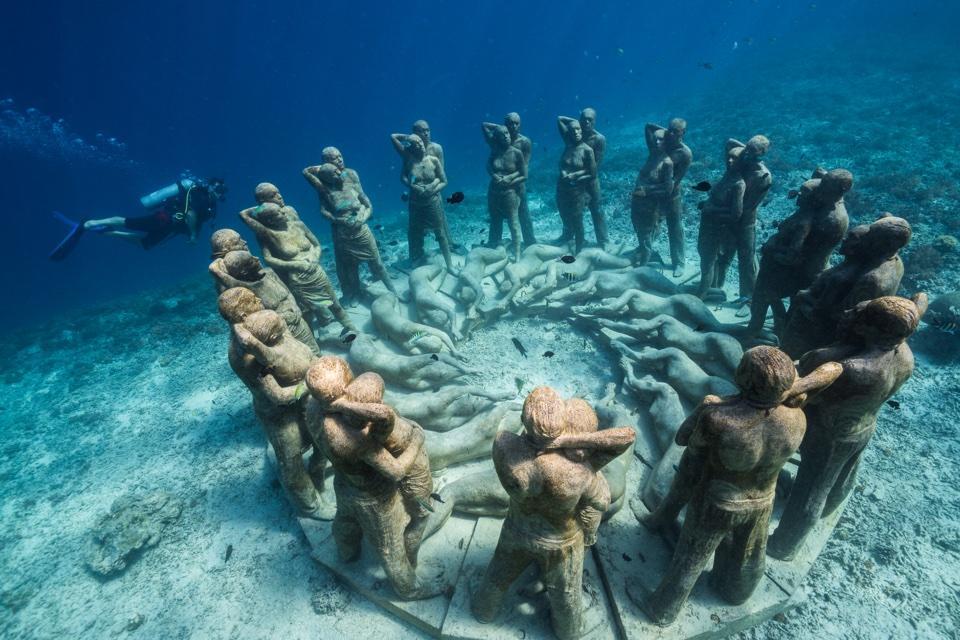
The figures stand on open sand, not on coral. A ring of cement bodies, some kneeling, some upright, sits in shallow water a short swim off the west coast of Gili Meno. The Gili Islands snorkeling statues work less like a dive site and more like an open-water installation, left to the sea by sculptor Jason deCaires Taylor. Coral polyps, sponge and algae have colonised the cement, so the surface texture changes from one season to the next. Reef fish patrol the gaps. What pulls visitors in is the silhouette: in good light, the ring reads as a single shape from the surface. Conditions, not opening hours, govern access. There is no gate and no turnstile here, and the water is open around the clock, which leaves wind, tide and traffic to do the gatekeeping. Afternoon breeze off the Bali Sea builds surface chop. Boats shuttling between Gili Meno, Gili Trawangan and Gili Air stir the shallows and cut visibility. Tide height decides how far a snorkeller floats above the sand bed. None of that appears on a timetable, so experienced visitors read the sea from the beach before they commit to a swim. Two approaches dominate. Confident swimmers go from the shoreline with mask, snorkel and fins, all three available from rental shops along the island paths. Everyone else takes a seat on an island hopping snorkel trip, the standard circuit that pairs the patung bawah laut with the turtle hatchery and the drift reefs off Gili Air, often with a glass-bottom boat for non-swimmers. Both routes benefit from a briefing: where the figures sit relative to the beach, which way the current runs, and when to turn back. The takeaway is to treat the outing as open-water snorkelling rather than a sightseeing stop. A float or buoy helps the less confident. A camera is worth carrying only once the route feels familiar. Handled that way, the Gili Islands snorkeling statues give visitors the frame they came for — a human circle resting on pale sand, lit from above, with Lombok's ridgeline sitting behind the moored boats.
“Conditions, not opening hours, govern access to the ring on the sand.”
There are no official entrance fees to visit the Gili Islands snorkeling statues as they are located in public waters. Access costs depend entirely on whether you choose to swim from the shore or participate in a private or group boat tour.
Verdict: A typical visitor pays 0 IDR for entry, though expenses vary based on whether you rent equipment or hire a boat for transport.
The snorkeling statues are located off the west coast of Gili Meno, Gili Indah, Pemenang, North Lombok Regency, West Nusa Tenggara, Indonesia. Visitors can reach the site either by swimming directly from the shore or by booking a local boat tour.
Walk to the west coast of Gili Meno and swim from the shore
Local glass-bottom boat tour from Gili Trawangan or Gili Air
Plan your arrival for the 06:00–09:00 window to ensure calm water conditions and better visibility before the midday boat traffic begins.
The underwater installation known as NEST serves as both an art piece and a functional artificial reef. Created to facilitate marine regeneration, these sculptures provide a foundation for coral to colonize and thrive.
Jason deCaires Taylor sculpted 48 life-sized human figures arranged in a circular formation to represent the cycle of life.
The statues are constructed from high-density, pH-neutral concrete that encourages the natural settlement of coral polyps and marine organisms.
Designed as an artificial reef, the surfaces provide a stable substrate for hard and soft corals to grow and expand the local ecosystem.
The installation emphasizes the relationship between humans and the ocean, highlighting our role in protecting marine environments.
By drawing visitors to a specific site, the statues help divert snorkeling pressure away from fragile, natural reef areas nearby.
Over time, the structures have become a habitat for various species of fish, crustaceans, and other marine life seeking shelter among the figures.
The Nest statues on Gili Meno's west coast sit on a shallow reef where coral is slowly colonising the figures. Every fin kick and hand placed on the sculptures affects that growth, so conduct in the water matters more here than at an open sand site.
Everything you need to know about gili islands snorkeling statues
The statues, known as The Nest, are located off the west coast of Gili Meno. They are situated in shallow, clear water accessible to swimmers and snorkelers.
For the clearest water and fewest crowds, arrive between 06:00 and 09:00. Visiting during this window also provides the best light for photography.
There is no cost to view this attraction as it is submerged in public waters. You can access the site for 0 IDR by swimming or joining a boat tour.
Yes, you can swim to the site from the beach on the west coast of Gili Meno. Ensure you are a confident swimmer, as currents can change, and consider using a guide if you are inexperienced.
Many local boat operators offer trips that include the gili islands snorkeling statues as a primary stop. These tours often provide all necessary gear and safety instructions for exploring the coral reef environment.
Snorkeling here is generally safe, but you should always respect the marine environment and avoid touching the sculptures. Staying within the designated area helps protect the surrounding seagrass and coral life.
The sculptures were created by artist Jason deCaires Taylor to serve as an artificial reef and marine habitat. Over time, these figures have become colonized by coral, supporting the growth of the local ecosystem.
Gili Meno Snorkeling Tours
Read more Tickets & toursPrivate Snorkeling Tours in Gili Trawangan
Read more GuideGili Trawangan Snorkeling Prices
Read more GuideGili Air Snorkeling Costs
Read more Tickets & toursGili Islands Snorkeling Tours from Bali
Read more Tickets & toursGili Trawangan Snorkeling Tours
Read more Tickets & toursGili Air Snorkeling Tours
Read more